Brown historian Vazira Zamindar unveils Salomon Award-funded graphic novel
Zamindar received a 2022 Salomon Award which supported the creation of her recently published graphic novel.
PROVIDENCE, R.I. [Brown University] — A crowd gathered at Riffraff Bookstore in Providence on Thursday evening to listen to Vazira Zamindar, associate professor of history at Brown, read from and discuss her recently published book, “When We Are Strangers.”
The work is a collaboration between Zamindar and pioneering Indian graphic novelist, Sarnath Banerjee. Moving between history and fiction, the novel restitutes an anticolonial practice and a forgotten friendship between Mohandas Karamchand Gandhi and Khan Abdul Ghaffar Khan.
Zamindar was a recipient of a 2022 Richard B. Salomon Faculty Research Award from Brown’s Division of Research, which supported the creation of her publication.
“The Salomon Award placed its faith in a public humanities project that was experimental and collaborative as it moved across disciplinary and formal boundaries,” Zamindar said. “And while I think this is quintessentially Brown in spirit, there are not many resources for doing such a project. This faith was therefore extremely important.”

Gandhi and Medhi listen as Zamindar reads an excerpt from "When We Are Strangers."

Zamindar and graphic novelist Sarnath Banerjee collaborated on this multidimensional work.

A neon sign provided additional lighting in the corner of the Riffraff seating area.
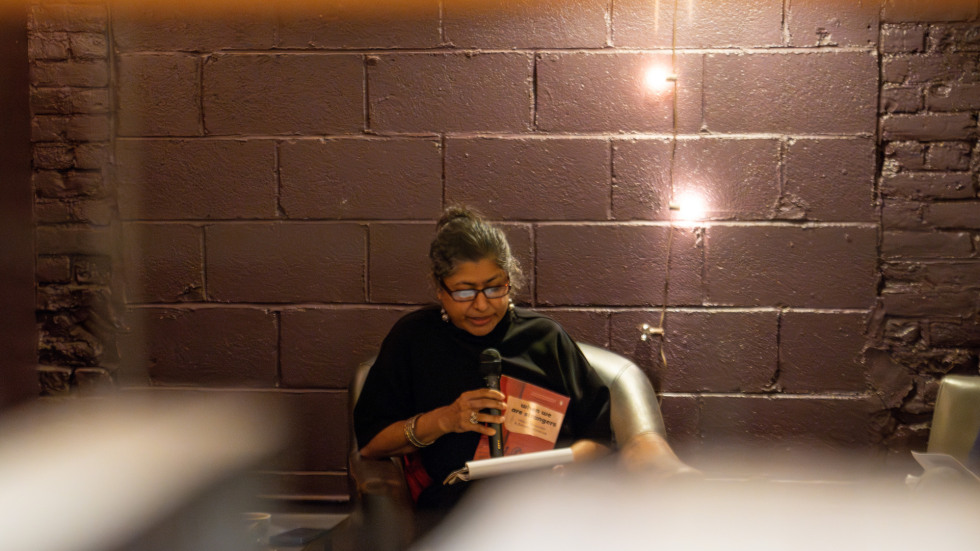
Zamindar as seen through a Riffraff bookshelf, a view some patrons resorted to due to the large crowd.

Patrons that didn't fit in the seating area huddled together around bookshelves to hear Zamindar.
The Salomon Award program was established in 1995 through a bequest from the late Richard B. Salomon, Chancellor of Brown University. Since 1999, the University has continued to fund the program.
Salomon Awards are designed to recognize excellence in scholarship and fund exceptional faculty research projects. Intended as non-renewable development grants, awards of up to $15,000 are granted for one year, with larger grants (up to $30,000) available exclusively for faculty in the arts, humanities, and humanistic social sciences.
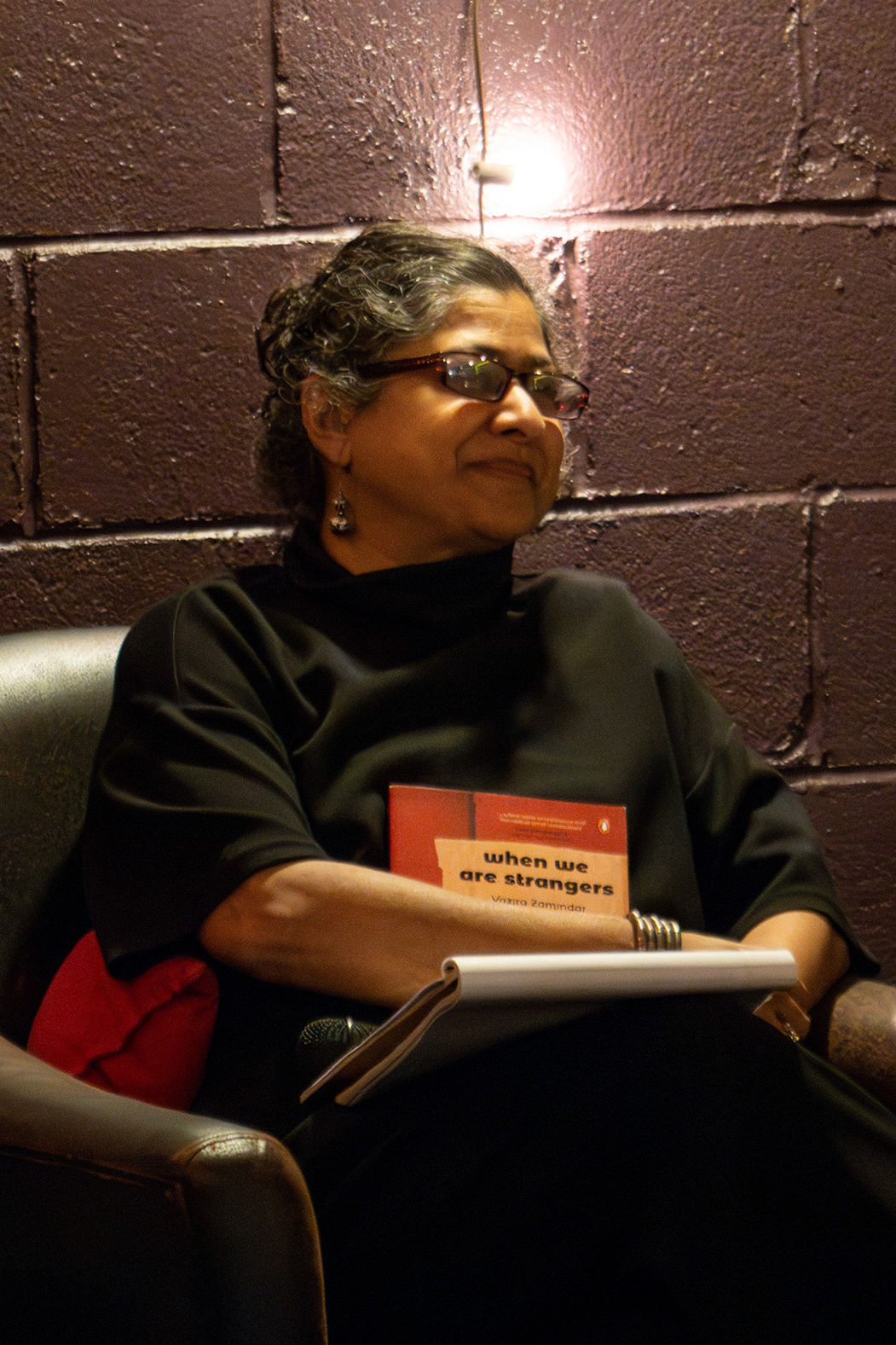
“[The Salomon Award’s] funds sustained a collaboration over several years with Sarnath Banerjee, a pioneering and one of the most important graphic novelists of India,” Zamindar said. “This extended my own thinking with what is a historian's archive, and how to produce a narrative.”
At Thursday’s event, Zamindar was joined in conversation by Leela Gandhi, John Hawkes Professor of the Humanities and English and director of gender and sexuality studies, and Abilash Medhi, assistant professor of history at Mt. Holyoke College.
Zamindar opened the event by reading an excerpt before she, Gandhi and Medhi discussed the novel’s journey through acts of care, self-discovery, friendship and steadfast faith.
The seating area at Riffraff was completely full, with every table and chair taken. Attendees who arrived shortly after the start of the reading spilled out of the seating section and resorted to peering around bookshelves to catch the conversation.
Zamindar also noted the impact the Salomon Award had on her ability to collaborate with partners beyond Banerjee.
“[The award] also funded bringing in a book designer so that we could further experiment with form,” Zamindar said. “In addition, several Brown students, including UTRAs, worked on the project, as well as students in both India and Pakistan.”
Learn more about the Salomon Award.